
Play Wild Swarm Now!
Home → Strategy
Wild Swarm Strategy
Approaching Wild Swarm sensibly
Push Gaming developed Wild Swarm in 2020 as a medium-high volatility slot with a theoretical return to player rate of 97.03 percent. This percentage represents the long-term average payout over hundreds of thousands of spins, not a guarantee for any single session. Beginners should understand that the house edge remains fixed at 2.97 percent regardless of the strategy employed during play. The game features Bee Feature wilds and honeycomb multipliers which increase variance but do not alter this mathematical reality.
The maximum win potential in Wild Swarm is capped at 3,100 times the total stake amount placed on a spin. This ceiling limits the upside compared to high-variance titles like Razor Shark, which offers a significantly higher max win of 85,475x. Players seeking larger payouts might consider alternatives, but Wild Swarm provides a more balanced risk profile suitable for extended play sessions. The 5x4 reel layout supports 20 fixed win lines, ensuring frequent small wins that help sustain the bankroll during dry spells.
RTP configurations for this title can vary across different casino operators, with some versions offering rates as low as 88.41 percent. A lower configuration increases the house edge substantially, meaning players lose money faster than on the standard 97.03 percent version. It is crucial to verify the specific RTP setting before starting to play, as this figure directly impacts long-term profitability. Beginners should always check the paytable or game rules to confirm they are accessing the highest available return tier.
Bankroll rules that hold up
A sensible bankroll for Wild Swarm should be sized to withstand the medium-high volatility inherent in Push Gaming’s design. Since the game features Bee Feature wilds and honeycomb multipliers, losing streaks can occur between bonus triggers without warning. Setting aside a specific amount ensures that players do not exceed their financial limits during these inevitable downswings. This disciplined approach prevents emotional decision-making when facing consecutive losses on the 20 win lines.
Flat betting involves wagering the same stake amount on every spin throughout the entire gaming session. This method contrasts with progressive staking, where players raise bets after losses, a strategy that only accelerates the depletion of funds. By maintaining a constant bet size, beginners can better predict how many spins their bankroll will support. For example, a €100 bankroll with a €1 per spin bet allows for one hundred attempts before the limit is reached.
Theoretical calculations suggest that a bankroll of at least 100 times the average bet helps mitigate the risk of ruin. With Wild Swarm’s 97.03 percent RTP, the expected loss per hour depends heavily on the speed of play and stake size. Beginners should calculate their hourly cost by multiplying the bet per spin by the number of spins per minute. This simple arithmetic provides a clear view of how long the session will last before the bankroll is exhausted.
Bet sizing against volatility
Wild Swarm operates on a 5x4 grid with 20 fixed win lines, requiring a bet that covers all active paths for maximum coverage. The minimum stake typically starts at €0.20, while the maximum allowed bet may reach €100 per spin depending on the operator. Beginners should start with smaller bets to familiarize themselves with the Bee Feature wilds and honeycomb multiplier mechanics. Higher stakes amplify both wins and losses due to the medium-high volatility classification of the slot.
The 97.03 percent RTP indicates that for every €100 wagered, the game returns €97.03 on average over a very long period. This mathematical certainty means that bet sizing does not influence the house edge, which remains constant at 2.97 percent. However, larger bets increase the variance of individual sessions, leading to more extreme swings in the bankroll balance. Players must accept that no betting system can overcome this built-in mathematical advantage held by the casino.
Comparing Wild Swarm to Bamboo Big reveals differences in structure that affect optimal bet sizing strategies. Bamboo Big features 6 rows and a higher volatility rating, often resulting in longer periods without significant payouts. Wild Swarm’s 5x4 layout and medium-high volatility offer a more consistent flow of smaller wins alongside occasional large hits. Beginners should adjust their stake levels based on personal tolerance for these fluctuations rather than chasing perceived patterns.
Session limits worth setting
Setting a time limit for each Wild Swarm session helps prevent fatigue-induced errors and excessive spending during play. Push Gaming’s engaging Bee Feature wilds and honeycomb multipliers can create an illusion of control, encouraging longer play than intended. Beginners should decide in advance how many minutes they will spend at the keyboard before taking a break. This discipline ensures that decisions remain rational and are not influenced by the excitement of near-misses or bonus triggers.
A loss limit defines the maximum amount a player is willing to forfeit during a single gaming session. For Wild Swarm, this figure should be calculated based on the total bankroll set aside for entertainment purposes. If the loss limit is reached, the session must end immediately, regardless of whether the free spins feature is available. This rule protects beginners from attempting to recover losses through increasingly risky behavior or larger bet sizes.
Win goals provide a positive target that encourages players to secure profits before the house edge takes its toll. A reasonable win goal for Wild Swarm might be 50 percent of the initial deposit or bankroll allocation. Once this threshold is crossed, cashing out preserves the profit and acknowledges the successful session. The maximum win cap of 3,100x serves as an absolute upper bound, reminding players that huge jackpots are statistically rare events.
Why chasing losses fails
Chasing losses involves increasing bet sizes after losing rounds in an attempt to recoup previous deficits quickly. This strategy ignores the independent nature of each spin in Wild Swarm, where the Bee Feature wilds trigger randomly. Progressive staking does not change the 2.97 percent house edge or the 97.03 percent RTP of the game. Mathematically, raising stakes only shortens the time until the bankroll is completely depleted, accelerating financial ruin.
The medium-high volatility of Wild Swarm means that losing streaks are a normal part of the gameplay experience. Players may experience dozens of spins without hitting a major combination before the honeycomb multiplier trail activates. Attempting to fight these statistical realities by doubling bets leads to rapid exhaustion of funds. Beginners must accept that variance cannot be manipulated, and no betting progression can overcome the built-in casino advantage.
Comparing Wild Swarm to other titles like Book of Dead highlights the importance of realistic expectations regarding variance. Book of Dead has a high volatility rating and a max win of 5,000x, appealing to risk-tolerant players. Wild Swarm’s 3,100x max win and 97.03 percent RTP offer a different risk-reward profile suited for steady play. Chasing losses in either game is futile because the outcome of each spin is determined by a random number generator.
Wild Swarm: key facts
| Parameter | Value |
|---|---|
| Game | Wild Swarm |
| Studio | Push Gaming |
| Released | 2020 |
| RTP | 97.03% |
| House edge | 2.97% |
| Volatility | medium-high |
| Max win | 3,100x |
| Reels | 5x4 |
| Paylines / ways | 20 win lines |
Common systems and their limits
Wild Swarm is a slot from Push Gaming featuring 20 win lines, meaning payouts require specific symbol alignments on those fixed paths rather than adjacent clusters. The game uses a 5x4 reel layout, which restricts the total number of possible outcomes per spin compared to wider grids like 6-reel formats. This structural limit ensures that the 97.03% RTP applies strictly to these 20 defined paylines, excluding any hypothetical broader coverage.
The Bee Feature wilds substitute for other symbols to complete winning combinations across the 20 active lines, directly influencing the hit frequency. Since the reels are fixed at 5x4, the probability of landing these wilds depends on the static grid size rather than dynamic row changes. Players cannot alter the number of active lines, so every spin engages the full 20-payline structure regardless of stake size.
Flat betting explained
Flat betting requires the player to wager the same amount on every single spin throughout the session, maintaining a constant exposure level. For Wild Swarm, this strategy avoids the mathematical trap of progressive staking by keeping the expected loss rate proportional to the total spins played. The house edge remains at 2.97%, ensuring the theoretical return stays consistent regardless of short-term variance in wins or losses.
This approach stabilizes the bankroll decay curve, preventing rapid depletion during cold streaks common in medium-high volatility slots. By not increasing stakes after losses, the player avoids the ruin scenario where bets exceed available funds before a winning cycle occurs. The maximum win cap of 3,100x remains achievable under flat betting, provided the session lasts long enough to trigger the honeycomb multiplier trail.
Progressive staking risks
Progressive staking involves raising the bet size after each loss, a method that does not change the built-in 2.97% house edge of the Push Gaming title. While it aims to recover previous losses with a single win, it exponentially increases the risk of hitting the table limit or depleting the bankroll. The 97.03% RTP is calculated over millions of spins, rendering short-term recovery strategies mathematically ineffective against the long-run average.
The volatility of medium-high means extended losing sequences are statistically probable, causing progressive bets to escalate beyond sustainable levels quickly. Unlike crash games with cash-out buttons, Wild Swarm offers no mechanism to mitigate losses mid-spin, leaving the player exposed to the full negative expectation. A bankroll set aside for play must account for the worst-case drawdown without relying on recouping losses through increased wagers.
What the maths actually allows
The theoretical return of 97.03% indicates that for every 100 units wagered, approximately 97.03 units are returned to players over an infinite horizon. This figure represents the average outcome across hundreds of thousands of spins, never a guarantee for a single session or even a weekend of play. The remaining 2.97% constitutes the casino's advantage, which accumulates steadily as the number of spins increases due to the law of large numbers.
Other configurations exist with lower RTPs, such as 88.41%, which drastically increase the house edge and reduce long-term viability for the player. Comparing Wild Swarm to titles like Big Bass Splash (96.71%) shows that even small percentage differences compound significantly over time. Players should verify the specific RTP setting of their version, as reduced-RTP configurations offer substantially worse value than the standard 97.03% model.
Reading variance honestly
Medium-high volatility in Wild Swarm implies that wins occur less frequently but tend to be larger when they do happen, driven by the growing multipliers. The maximum win of 3,100x is a hard cap, meaning no single spin or feature combination can exceed this payout limit regardless of bet size. Players must have sufficient bankroll depth to withstand dry spells between high-paying events, as the variance distribution is skewed toward fewer, bigger hits.
This variance profile differs significantly from high-variance slots like Le Cowboy, which has a much higher max win of 25,000x but potentially longer droughts. The free spins feature with growing multipliers is the primary vehicle for approaching the 3,100x cap, requiring precise timing and luck to activate. Understanding this distribution helps manage expectations, as the path to large wins is irregular and not linearly correlated with time spent playing.
Learning the game in demo first
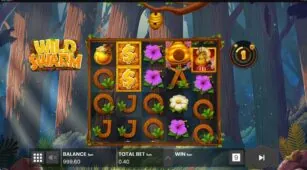
The reel layout of Wild Swarm features a 5x4 grid with 20 win lines, providing a structured framework for beginners to understand symbol alignment without financial risk. Push Gaming designed this specific configuration to allow players to observe the Bee Feature wilds and honeycomb multiplier trail mechanics in real-time during free play sessions. Understanding these visual cues helps users recognize how multipliers accumulate across consecutive wins before committing actual funds to any spin.
The theoretical return to player (RTP) stands at 97.03% for this title, representing the long-term average payout percentage over hundreds of thousands of spins. This figure serves as a critical baseline for new players to compare against other slots like Buffalo which offers 94.85%, ensuring they select games with favorable mathematical edges. Familiarity with such statistical benchmarks allows novices to set realistic expectations regarding potential returns and manage their bankroll more effectively over extended play periods.
Volatility is classified as medium-high, indicating that wins may occur less frequently but tend to be larger when they do hit within the 5x4 structure. This characteristic distinguishes Wild Swarm from lower volatility titles like Sizzling Hot Deluxe, requiring players to withstand longer dry spells while waiting for significant payouts. Recognizing this pattern early in demo mode prevents emotional decision-making and helps maintain discipline when transitioning to real-money gameplay on platforms offering the 300% welcome bonus.
Adjusting stakes to your budget
Flat betting involves wagering the same stake every round, which preserves the built-in house edge of 2.97% while extending the longevity of your session. For a bankroll of 100 €, setting a constant bet of 1 € results in approximately 100 spins before depletion, allowing ample time to trigger features like free spins with growing multipliers. This conservative approach minimizes variance impact and provides a stable environment for learning the game mechanics without rapid capital erosion or unnecessary stress during initial plays.
Progressive staking strategies involve raising stakes after losses, a method that does not alter the mathematical advantage held by the casino and only accelerates the time to ruin. Increasing bets following a losing streak in Wild Swarm can quickly deplete a modest bankroll, especially given the medium-high volatility that already produces irregular win patterns. Avoiding such aggressive tactics ensures that players remain within their predetermined limits and can fully experience the maximum win potential of 3,100x without premature account exhaustion.
Understanding the maximum win cap of 3,100x helps players gauge the potential upside relative to their initial investment and adjust their stake sizes accordingly. A higher stake increases the absolute value of this cap but also raises the risk of busting before reaching it, particularly compared to games like Sweet Bonanza Super Scatter with its 50,000x max win. Balancing stake size with the RTP of 97.03% ensures that players maximize their expected value while maintaining sufficient funds to cover multiple spins and feature triggers.
Recognising a bad session
A session becomes problematic when the bankroll depletes rapidly due to chasing losses through progressive staking rather than adhering to a fixed betting strategy. If a player starts with 50 € and loses it within ten minutes while attempting to recover deficits, the medium-high volatility of Wild Swarm has worked against them excessively. This rapid depletion signals a failure to respect the house edge of 2.97% and indicates that emotional decisions are overriding rational bankroll management principles established beforehand.
Monitoring the frequency of hits against the expected volatility helps identify when luck deviates significantly from the theoretical norm over a short period. Since Wild Swarm offers an RTP of 97.03%, prolonged periods without significant wins despite consistent flat betting suggest unfavorable variance rather than a broken system. Players should recognize this statistical reality and avoid increasing stakes in hope of immediate recovery, which often leads to further financial loss and frustration during the gaming session.
Comparing current performance against known benchmarks like the 20 win lines and 5x4 reel layout can reveal if the game behavior aligns with standard expectations. Deviations from typical patterns, such as extended droughts exceeding normal volatility ranges, warrant pausing play to reassess the strategy and prevent impulsive decisions. Maintaining awareness of these metrics ensures that players can objectively evaluate their session progress and make informed choices about continuing or stopping based on factual outcomes rather than emotions.
Stopping while ahead
Setting a target profit level based on the maximum win potential of 3,100x provides a clear objective for exiting a session while maintaining positive equity. If a player achieves a significant multiplier during free spins with growing multipliers, cashing out secures gains before the medium-high volatility potentially erodes them through subsequent spins. This disciplined approach contrasts with games like Le King, where high max wins might encourage holding on for larger payouts despite higher risks of reversal during play.
Calculating the expected value of continuing play versus securing current profits involves weighing the remaining bankroll against the probability of triggering further features. With an RTP of 97.03%, the mathematical expectation slightly favors the casino over time, making it prudent to lock in winnings once a comfortable surplus is achieved. This strategy protects the player from giving back accumulated gains to the house edge of 2.97% and ensures that the session concludes with a net positive result for the bankroll.
Implementing a stop-loss limit alongside a take-profit threshold creates a balanced framework for managing risk and reward during gameplay. By defining these boundaries in advance, players can avoid the temptation to chase losses or greedily hold onto profits until they vanish. This structured method aligns with responsible gaming practices and leverages the predictable nature of the 20 win lines to ensure sustainable engagement with Wild Swarm over the long term.
Responsible play in practice
Treating the 300% welcome bonus up to 2,000 € plus 100 free spins as entertainment expenditure rather than an investment opportunity sets realistic expectations for outcomes. Understanding that the bonus funds come with wagering requirements helps players navigate the terms without assuming guaranteed profits from the initial promotion. This perspective encourages mindful spending habits and prevents the misconception that promotional offers provide a mathematical advantage over the standard house edge inherent in slot games.
Utilizing tools provided by operators to monitor playing time and deposit limits supports adherence to responsible gaming guidelines while engaging with Wild Swarm. Setting daily or weekly caps on spending ensures that the medium-high volatility does not lead to excessive losses beyond what the player can comfortably afford. These measures complement the theoretical RTP of 97.03% by imposing external constraints that protect the bankroll and promote healthy gaming behaviors independent of game-specific statistics.
Educating oneself on concepts like volatility and hit frequency empowers players to make informed decisions about stake sizes and session durations. Knowledge of how features like the Bee Feature wilds interact with the 5x4 grid enhances understanding of game mechanics without influencing the underlying randomness. This educational approach fosters a respectful relationship with gambling as a form of leisure, emphasizing skill in bankroll management over reliance on chance or unproven betting systems.
DemoRTP & VolatilitySymbols & PayoutsBonus FeaturesStrategyBonusesMobileDownload & AppMax WinSimilar GamesReviewFAQSitemap
Wild Swarm 2026